Welcome to Eugene Eye Care. We are pleased to introduce you to the art of cataract surgery, and explain how the removal of your cataract represents an opportunity to improve your vision.
Your Vision
 Before we go on, take a moment to consider your vision. Just as every person is unique, every person’s vision is unique. Some are blessed with excellent vision from birth, and are able to function without corrective lenses of any kind. Others are born with eyes that require corrective lenses such as contacts or glasses from an early age.
Regardless of whether or not you have needed glasses before, when cataracts are removed, the playing field is leveled. If you have needed strong glasses all your life, you will likely be less dependent on them after surgery. However, even if you did not need glasses before, there is a chance that you may need them after surgery! On this web page, we will explain how the use of glasses can be minimized or even eliminated through modern surgical techniques.
Reading Glasses
At the age of about 45 everyone begins to experience a condition known as “presbyopia,” or the need for reading glasses. For those who already wear glasses, bifocals become necessary. For those lucky few who never needed glasses before, reading glasses usually become necessary.
 Since most patients who visit our office with cataracts are seniors, the concept of presbyopia is all too familiar. However, cataract is a condition that affects people of all ages. If you are younger than 45 years old, or if you have never needed reading glasses it is especially important for you to grasp this concept. After your cataracts are removed, your vision will change and you WILL experience the need for corrective lenses to help you see things that are up close.
If you would like to be less dependent on glasses after your cataract procedure, read on: we will explain in detail the options that are available to you.
What is a Cataract?
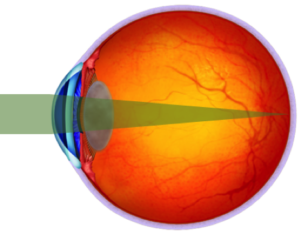
The majority of patients that we see in the office are a little unclear on exactly what a cataract is. To understand, think of your eye like a camera. When light enters a camera it is focused by a lens.
Much like a camera, your eye also has a lens. The lens in your eye starts out clear, but becomes increasingly cloudy as time passes. When this cloudiness reaches a certain point, instead of focusing light, the lens scatters light!
Usually, it happens so slowly that patients don’t even notice until the condition is very advanced! Eventually, however, most people notice problems with hazy vision, glare, and difficulty driving at night. It is at this point when patients are ready to seek help.
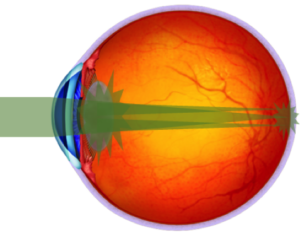
Although cataracts can happen at any age, any person who is blessed with long life will eventually develop a cataract. In fact, 3 million Americans undergo cataract surgery every year, making cataract surgery the most common surgical procedure in America.
Although this procedure is safe, as with any medical procedure, the only guarantee that can be made is that your surgeon will do his or her absolute best to give you the most excellent vision possible.
After the cataract has been removed, we have a unique opportunity to customize your vision. This is not a one-size-fits-all solution. Every patient has different needs, and each eye is unique. We can help you make this choice after talking with you and examining your eyes. This web page will introduce the options available now, before you consult with your surgeon, so that we can all make the most of our time together.
Vision Correction
In order to restore vision, we must not only open a path for light to enter the eye—we must bend that light to a sharp focal point. When a cataract is removed, we are faced with the task of focusing light into the eye. To obtain a clear point of focus, a corrective lens is always required; this lens can be placed in front of the eye (as is the case with glasses), on the surface of the eye (a contact lens), or it can be implanted permanently inside the eye.
 Although ALL patients who undergo cataract surgery now receive an implanted lens, many patients ALSO require glasses to fine tune their vision as well. The reason for this is that the prescription in the implanted lens must be predicted BEFORE surgery. Once in the eye, the lens implant is permanent and cannot easily be changed! Although our predictions are fairly accurate, about 30% of the time, patients will need some further correction to see well enough to pass their driver’s’ test. Therefore, it is important that we develop a plan for how your vision will be fine-tuned after surgery. This plan may be as simple as the expectation of wearing glasses. However, if wearing glasses is something you would like to avoid, options exist to correct your vision with less dependence on glasses.
Expectations
In days gone by, cataract surgery was only done in cases of severe vision loss. The surgery was risky, required hospitalization for a week or more, and the recovery of vision could take months; even then, very strong glasses were usually required to see.
Nowadays, the bar is set much higher. We aim to not only safely remove the cataract in an efficient and painless procedure, but we also desire to quickly restore your vision in such a way that dependence on corrective lenses may be minimized or eliminated.
 One of the most important factors in achieving a successful surgical result is for us, your surgeons, to make sure that your expectations are within the realm of what we can provide using the available surgical techniques and technology.
Nearly every patient with cataract knows someone who has already gone before them. Most folks say, “I am nervous to have my eyes worked on—but at the same time I am looking forward to seeing better. My neighbor had cataract surgery and now he doesn’t wear glasses.” While not wearing glasses is a common outcome of cataract surgery, it is not attainable for everyone to go without glasses. If your expectation is to achieve a glasses free lifestyle, we definitely need to discuss a plan for meeting that expectation!
Stop and consider what your expectations are regarding what your vision will be like after your surgery. It doesn’t matter what your vision is like now—this procedure puts everyone on an equal footing. If you need glasses now, you may not after surgery. If you do NOT need glasses now, please realize that you may become dependent on glasses unless we develop a specific plan to achieve the result you desire!
Setting Vision Goals
Consider the following questions:
- Do you currently wear glasses for distance activities like driving or tennis?
- Do you currently depend on glasses for near activities like reading labels or using the computer?
- Would you like to be less dependent on glasses after your procedure?
 If the answer to the last question is yes, then we should set some goals for your vision. Your surgeon’s role in this process is to compare your expectations with what can reasonably be attained using the surgical tools available. Your vision counselor’s role will be to analyze your insurance benefits to determine what the monetary cost of achieving our goal will be.
You will then weigh the benefits against the costs and let us know what level of vision correction best meets your needs.
We will now explain some of the options we have available to make your surgery the most enjoyable experience possible. We will also introduce the concept of setting goals for your vision so that you will be able to select the vision correction plan that best meets your needs.
Overview of Surgery Options
We have several levels of care to choose from. To make things understandable, we have ranged these options in order from good, better, and best:
Standard Plan
Goal: A modern surgical experience with the understanding that glasses will be needed to see clearly for driving and reading.
Patients will receive a care package including useful sunglasses. Although glasses will likely be required since no specific vision correction is planned, a glasses prescription is included with this plan. An important benefit to this plan is the inclusion of advanced diagnostic eye imaging tests which help to exclude the possibility of undiagnosed eye diseases such as glaucoma, macular degeneration, or astigmatism.
Toric Plan
Goal: An improved surgical experience targeting excellent vision without glasses for a specific visual focal length that brings some independence from glasses through the correction of the patient’s astigmatism.
Toric Plan patients enjoy all the benefits of the Standard Plan. Specialized surgical techniques will be used to target excellent vision for a specific target whether it is distance, intermediate or near vision. With that plan, you should be able to achieve spectacle independence either to drive and watch TV, or to do computer work or to read and do near tasks without glasses. You will need glasses for what you are NOT corrected for. For instance, if you are corrected for near vision, you will need glasses for distance and computer work. If you are corrected for distance vision, you will need glasses for computer work and near tasks. If you are corrected for intermediate/computer distance, you will need glasses for distance and near vision..
Multifocal Plan
Goal: An improved surgical experience targeting excellent vision for driving and reading without the aid of glasses.
This comprehensive vision correction plan is available only to select patients whose eyes are very healthy, and who have no medical eye problems other than cataract. Inclusive of all the benefits of the Toric level, Multifocal Plan patients will be minimally dependent on glasses, being able to achieve excellent distance and near vision without correction.
 Summary
So to review, we have 3 levels of vision correction for you to choose from with each plan offering an additional benefit to your vision. The Standard Plan treats the cataract with the expectation that glasses will be needed for all distances; with the Toric Plan, spectacle independence is obtained for a specific distance and glasses are needed for other distances, and with the Multifocal Plan, a goal is set for excellent distance and near vision without glasses.
Our aim is to assist you in obtaining your best possible vision. Please call us to set up a consultation any time at 541-687-1715.
- Standard Will need glasses post-surgery
- Toric Choose glasses-free for distance, intermediate, or near vision with glasses for other distances.
- Multifocal Usually glasses-free, may need occasional use of reading glasses
After your consultation with your surgeon, you will meet with a vision counselor who will analyze your insurance benefits so that you can make an informed decision on which plan is right for you.